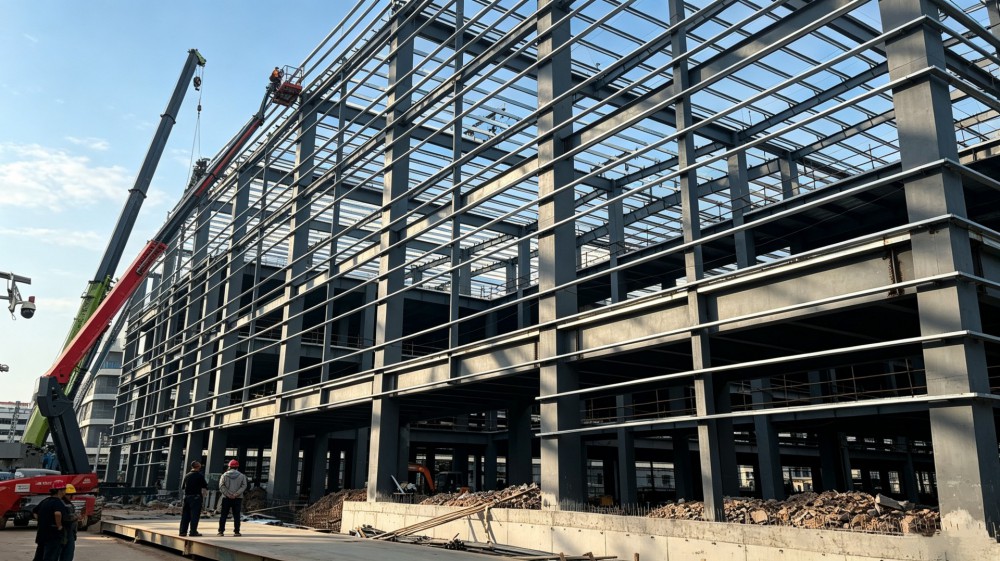
Southeast Asia & Middle East Data Center Steel Demand 2026 | Hongsheng Steel Structure
Southeast Asia and the Middle East Are Buying Steel Fabrication Capacity, Not Steel.
Two figures frame the 2026 structural steel market.
The first: apparent steel consumption across ASEAN's six largest economies is forecast to reach 87.9 million tonnes in 2026, up 2.6% year on year and 8.2% above 2024 levels, according to the Southeast Asia Iron and Steel Institute (SEAISI).
The second: Malaysia alone had 143 data center projects approved by mid-2025, representing announced investment of close to RM150 billion.
Both numbers point to the same conclusion. The constraint in these markets is no longer steel supply. It is the fabrication capacity — cutting, drilling, welding, blasting, coating and packing — required to turn sections into members that arrive on site in sequence, at tolerance, with documentation attached.
The Global Backdrop
The global structural steel market was valued at USD 123.4 billion in 2025 and is projected to reach USD 202.1 billion by 2033, a compound annual growth rate of 6.7%, per Grand View Research. Asia Pacific accounted for 69.4% of 2025 revenue, and beams alone represented 32.0% of product-segment revenue.
Growth is not evenly distributed. Two regions are reshaping demand:
Southeast Asia. The region's steel imports remain large — around 50 million tonnes in 2025 — with SEAISI putting import penetration at 60% or higher. Domestic production leans toward rebar and flat products; high-quality structural sections come from overseas. Vietnam's structural steel fabrication market alone is estimated at USD 2.26 billion in 2026, heading toward USD 3.13 billion by 2031 (Mordor Intelligence).
The Middle East. Saudi Arabia's Vision 2030 giga-projects have passed USD 1.25 trillion in cumulative announced value. The clearest data point for our industry: NEOM's Oxagon has signed a USD 5 billion partnership for a 1.5 GW AI data center campus, with the first phase targeted for 2028. Every megawatt of that capacity sits inside a steel frame.
Why Steel, and Why Now
In tropical Southeast Asia, monsoon season can halt poured concrete for weeks. Prefabricated steel removes that dependency: the frame is fabricated while groundworks proceed, then erected in days rather than months. For a hyperscale facility chasing a launch date, that difference decides the schedule.
Steel also suits the region's seismic profile. Indonesia's building zones reward high-ductility frames, which reduce structural weight and foundation cost simultaneously.
And it suits the asset's lifecycle. AI hardware refreshes every 18 months; a steel frame can accept mezzanine additions and floor reinforcement that a concrete structure cannot.
What Buyers Are Actually Specifying
Across projects in Indonesia, Malaysia, Thailand and the Gulf, procurement patterns have converged on four points:
Mixed international standards. A single project may combine ASTM A572 Gr50 main-frame beams, EN S235JR secondary steel and JIS SS400 bracing. Consolidating these into one fabrication order avoids triple freight and triple coordination.
Corrosion class stated explicitly. Coastal Southeast Asian sites typically specify C4 or C5 under ISO 12944; Gulf coastal sites frequently specify C5. Vague coating clauses are the leading cause of site rework.
Documentation as a deliverable. Mill certificates to EN 10204 3.1, heat-number traceability, and inspection records that a third party can audit before a container is released.
Container-level packing logic. Members segmented for erection sequence, not for workshop convenience.
What This Means for Supplier Selection
The question procurement teams should ask in 2026 is not "what is your annual tonnage." It is:
Which corrosion classes have you coated to, and can you show DFT and adhesion records?
How do you qualify welding procedures, and at what NDT ratio?
Can you demonstrate container manifests from a comparable project?
At Hongsheng Steel Structure, our 80,000 m² plant, eight fabrication workshops and 100,000-tonne annual output exist to answer those questions at scale — and our EN 1090 certification means the documentation is already in the format European-facing projects require.
Collaborate with us immediately
If you have questions about steel structures or would like to discuss a project, please leave your contact details.